Your guide slows the vehicle, points at a grey shape in the bush, and says “black rhino.” You squint. It looks exactly like the one you saw yesterday at Lake Nakuru, which was apparently a white rhino. If you are planning your first Kenya safari, this black rhino vs white rhino mix-up is completely normal. Both animals are grey. Neither one matches its name. Here is how to tell them apart, and more importantly, where in Kenya you can actually find each one.
Why They’re Called Black and White When Both Are Grey
Neither rhino is black or white. The name comes from an old mix-up with the Afrikaans word “wyd,” meaning wide, which described the white rhino’s broad, square mouth. English settlers heard “wyd” and wrote down “white.” Once one rhino had a color name, people needed a way to describe the other, so it became the “black” rhino by contrast. No dye, no pigment, just a language mix-up over a century ago that stuck.
Black Rhino vs White Rhino: The Physical Differences That Actually Matter
Forget color. Here is what you can actually use in the field.
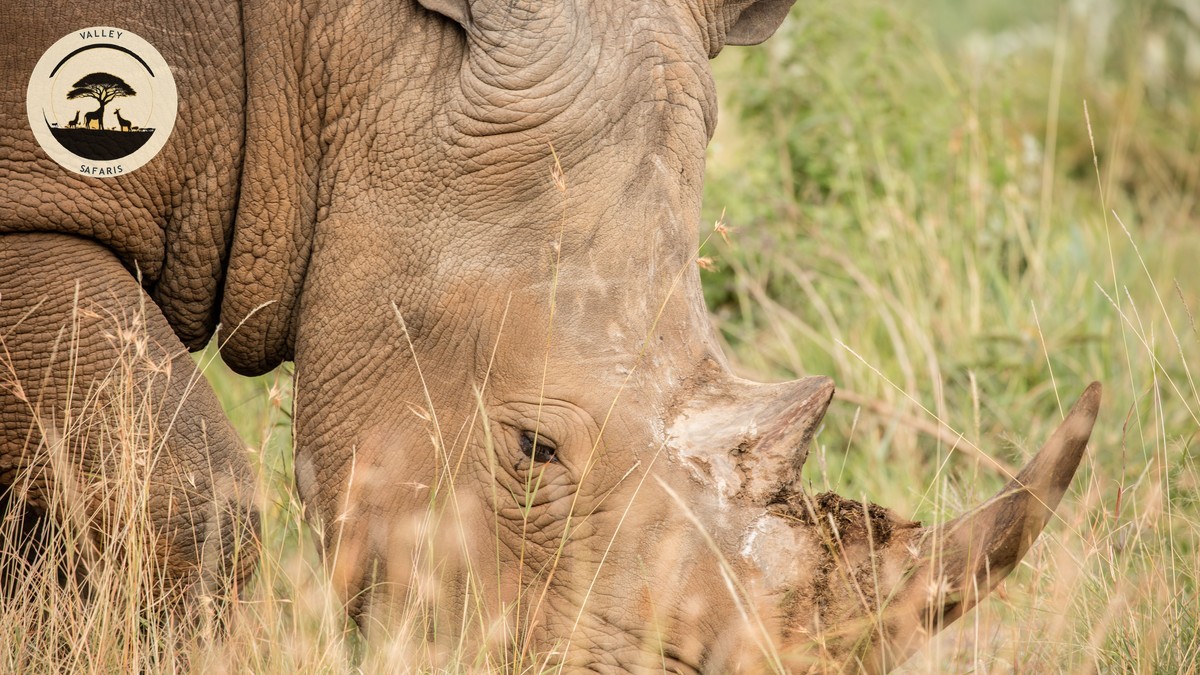
Lips. This is the fastest way to tell them apart. Black rhinos have a pointed, hooked upper lip built for grabbing leaves and twigs off bushes. White rhinos have a wide, square lip built for grazing grass close to the ground, like a lawnmower.
Size. White rhinos are bigger. Adult males can weigh over 2,300 kg. Black rhino bulls typically weigh around 1,400 kg, noticeably smaller and more compact.
Head and neck posture. White rhinos have a pronounced hump on the neck and carry their heads low, suited to grazing. Black rhinos hold their heads higher, since they browse at shoulder height rather than at the ground.
Ears. White rhino ears are larger and more tubular. Black rhino ears are rounder and set lower on the head.
Horns. Both species have two horns, but a black rhino’s horns tend to look thinner and more sharply defined against a smaller face, which can make them appear longer even when they are not.
Behavior: Loner vs Crowd
Black rhinos are mostly solitary and can be jumpy. Rangers describe them as quick to charge if startled, though true attacks on vehicles are rare. White rhinos are far more social. They gather in small groups called crashes, sometimes five or more animals grazing together, and are generally calmer around vehicles. This is one reason white rhino sightings feel easier and less rushed.
Diet: Grazer vs Browser
White rhinos graze, eating short grass much like a cow. You will usually find them in open grassland. Black rhinos browse, eating leaves, shoots, and twigs from shrubs and small trees, so they favor thicker bush country where visibility is lower and sightings take more patience.
Conservation Status and Numbers
Both species have come back from the edge, but not equally.
Black rhinos are Critically Endangered. The global population sits at roughly 6,200 animals, rebuilt slowly from a low of around 2,400 in the mid-1990s after decades of poaching.
Southern white rhinos are Near Threatened, numbering around 16,000, though poaching pressure has pushed that number down from a peak closer to 20,000 a decade ago. The northern white rhino subspecies is functionally extinct. Only two remain, both female, both living under armed guard at Ol Pejeta Conservancy in Kenya.
Where to See Black Rhino in Kenya
Black rhinos are shier and live in thicker bush, so sightings take more effort. Your best options:
- Ol Pejeta Conservancy, near Nanyuki, holds East Africa’s largest black rhino sanctuary, with over 140 individuals as of recent counts.
- Lewa Wildlife Conservancy, in Meru County, is one of Kenya’s best bets for both rhino species, with a strong black rhino population inside its fenced sanctuary.
- Tsavo West National Park protects black rhino inside the Ngulia Rhino Sanctuary in Tsavo West, a fenced 90 sq km enclosure set up in 1986 specifically to protect the species from poaching.
- Aberdare National Park offers a different kind of encounter entirely: night-time rhino sightings from The Ark in Aberdare National Park, where a floodlit waterhole draws rhino after dark.
Where to See White Rhino in Kenya
White rhino sightings are close to guaranteed at a handful of parks:
- Lake Nakuru National Park, a fenced sanctuary about 160 km from Nairobi, holds a healthy white rhino population grazing in open grassland near the lake shore.
- Ol Pejeta Conservancy again, home to both species, plus the last two northern white rhinos.
- Lewa Wildlife Conservancy, where white rhino graze the open plains alongside black rhino in the thicker bush.
Quick Comparison Table
| Feature | Black Rhino | White Rhino |
|---|---|---|
| Scientific name | Diceros bicornis | Ceratotherium simum |
| Weight (adult male) | ~1,400 kg | ~2,300 kg |
| Lip shape | Pointed, hooked | Wide, square |
| Diet | Browser (leaves, twigs) | Grazer (grass) |
| Social style | Mostly solitary | Semi-social, in crashes |
| Global population (approx.) | 6,200 | 16,000 (southern), 2 (northern) |
| Conservation status | Critically Endangered | Near Threatened |
| Best Kenya sites | Ol Pejeta, Lewa, Ngulia (Tsavo West), Aberdare | Lake Nakuru, Ol Pejeta, Lewa |
| Typical park/conservancy fee (indicative) | Ol Pejeta ~$90/day non-resident adult | Lake Nakuru ~$60/day non-resident adult |
Fees above are indicative ranges based on recent published rates and can change, so always confirm current pricing before you book.
Quick Field ID Tips
If you only remember three things, make it these. Square lip and low head means white rhino. Pointed lip and higher head means black rhino. If they are in a group of four or more, they are almost certainly white rhino, since black rhinos rarely gather that way.
The Valley Safaris Difference
Most guides can tell you a black rhino from a white rhino once you are standing next to one. What matters more is getting you there in the first place. We build itineraries around which conservancies have realistic sighting odds on the day you are traveling, not just which ones sound good in a brochure.
That means pairing a guaranteed white rhino sighting at Lake Nakuru with a patient, quieter morning at Ol Pejeta hunting for black rhino in the bush, timed around when our guides know the animals tend to move. We also handle the conservancy fees and permits ahead of time, so there is no confusion at the gate about what Ol Pejeta or Lewa charges on top of your park fees. Our guides know these reserves personally, often down to which waterhole a particular rhino favors that week.
FAQ
What is the main difference between a black rhino and a white rhino? The lip shape. Black rhinos have a pointed lip for browsing leaves. White rhinos have a square lip for grazing grass.
Which rhino is bigger? White rhinos are bigger, with adult males reaching over 2,300 kg compared to around 1,400 kg for black rhino bulls.
Which rhino is more aggressive? Black rhinos have a reputation for being more skittish and quicker to charge when startled, though serious incidents with vehicles are rare on organized safaris.
Are black rhinos more endangered than white rhinos? Yes. Black rhinos are Critically Endangered with about 6,200 left. Southern white rhinos are Near Threatened with about 16,000 left.
Can you see both species on one Kenya safari? Yes. Ol Pejeta Conservancy and Lewa Wildlife Conservancy both hold healthy populations of black and white rhino, often within the same game drive.
Is Ol Pejeta home to black or white rhino? Both. Ol Pejeta holds East Africa’s largest black rhino sanctuary and also protects the world’s last two northern white rhinos alongside southern white rhinos.
Plan Your Rhino Safari With Us
Seeing both species on one trip takes the right route and the right timing, not luck. Talk to our team about building a Kenya itinerary around Lake Nakuru, Ol Pejeta, and Lewa, or browse our rhino safari tours to see how we put it together.